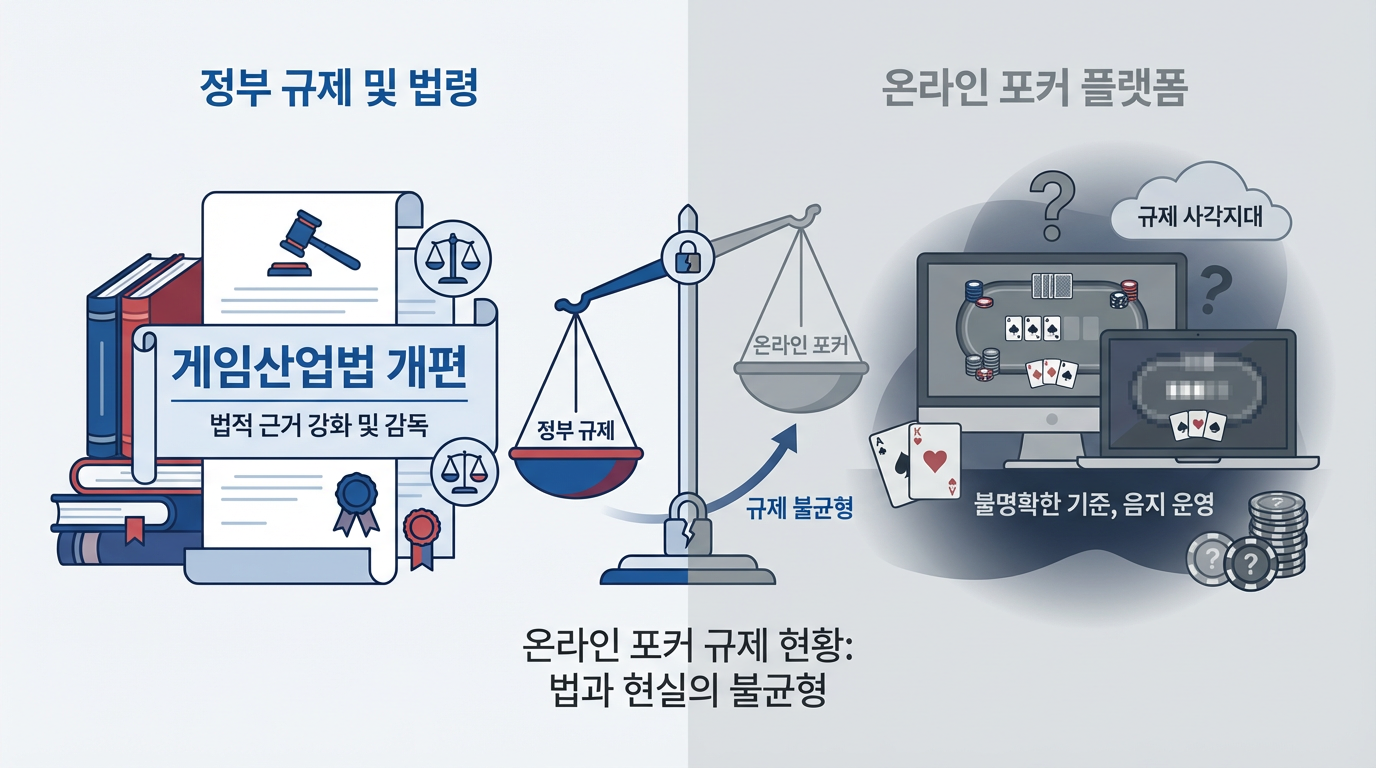
In 2026, the Korean game industry is facing a major legal overhaul for the first time in 20 years. As the full amendment to the Game Industry Act passes the National Assembly, regulations on digital games are being eased, while social casino games, including online poker, remain in an ambiguous position, heightening tension within the industry.
Web Board Game Monthly Payment Limit Raised to 1,000,000 KRW
On January 27, an amendment to the Enforcement Decree of the Game Industry Act was announced, raising the monthly payment limit for web board games such as Go-Stop and poker from the previous 700,000 KRW to 1,000,000 KRW. This is an additional easing measure after four years, since 2022.
With this decision, web board game operators like NHN and Neowiz are anticipating increased revenue. Leading domestic web board games such as Hangame Go-Stop and Pmang Poker have long faced growth limitations due to payment limit regulations. Industry officials expect this measure to revitalize the stagnant web board game market.
Game Industry Act Overhaul: Bifurcation into Digital and Arcade
The core of the new amendment is to manage games by separating them into ‘digital games’ and ‘arcade games’. For digital games, regulations have been significantly eased, including the abolition of game time limits, and the elimination of identity verification and legal guardian consent requirements for games rated for all ages.
On the other hand, for offline arcade games, existing levels of gambling-related regulations will be maintained. This marks a shift in direction for the strengthened gambling regulations, which were put in place after the Bada Iyagi incident in 2006, after 20 years.
Social Casino Poker as an Exception, Causing Industry Confusion
However, uncertainty still remains in the online poker game industry. Although the amendment states that it eases regulations on digital games, poker games with a social casino nature are in a regulatory blind spot due to a lack of clear mention.
In Korea, paid services and cash-outs for social casino games that mimic casino-style games such as slot machines, blackjack, and baccarat are currently prohibited due to their gambling nature. In particular, the Game Rating and Administration Committee has previously denied ratings classification for social casino games on several occasions.
The problem is that it is unclear whether online poker falls into this social casino category. Despite a structure that makes cash-outs impossible, it is not free from controversy over its gambling nature.
Establishment of Game Promotion Agency and Organizational Restructuring
The amendment also includes the establishment of the ‘Game Promotion Agency’ as a dedicated institution for promoting game culture and industry. The Game Promotion Agency will take over the game promotion policies of the existing Korea Creative Content Agency, and a separate ‘Game Management Committee’ will be established under the agency for managing gambling-related aspects.
In early February, the Game Rating and Administration Committee carried out a large-scale organizational restructuring and established the ‘Loot Box Damage Relief Center’. While the policy aims to strengthen user protection and post-management, specific guidelines for online poker games are still lacking.
Discrepancy with the Global Market
Korean online poker platforms are turning their attention to overseas markets due to domestic regulations. The global social casino game market is projected to grow to $8.3 billion, approximately 10 trillion KRW, by 2026. However, domestic companies are unable to properly enter this market due to gambling-related regulations.
Some point out that prohibiting even the sale of paid goods for games that lack a cash-out function is excessive regulation. Indeed, major countries, including the United States, legally operate social casino games where cash-outs are not possible.
Industry Demands Clear Guidelines
Online poker industry officials unanimously state that as this Game Industry Act overhaul aims to promote digital games, the urgent establishment of clear standards and guidelines for online poker is necessary. There are concerns that if a direction cannot be found between regulation and promotion, it could only weaken the competitiveness of domestic companies.
As the full amendment to the Game Industry Act is set to be fully implemented in 2026, it remains to be seen whether online poker platforms will benefit from regulatory easing or continue to remain in a blind spot.
Comments
0